The “Bhriguization” of Mahabharata
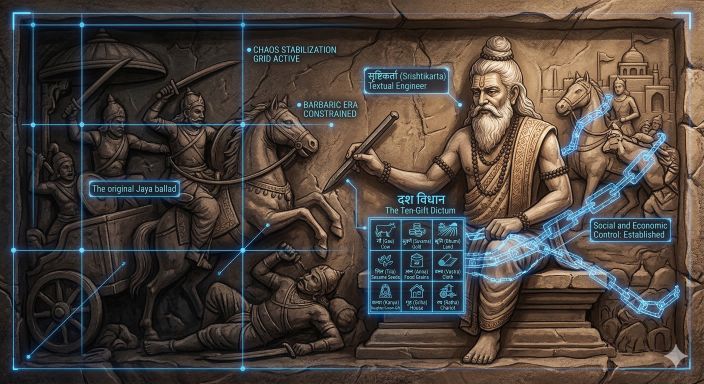
In his “Bhriguization” theory, V.S. Sukthankar observed that while the original Jaya was a heroic Kshatriya ballad, the text was later taken over by the Bhrigu and Angirasa clans of Brahmanas.
-
The Evidence: These clans inserted hundreds of legends (like the story of Parashurama) to demonstrate that Brahmana power (Brahma-tejas) is superior to warrior power (Kshatriya-tejas).
-
The Motive: By placing these long discourses in the mouth of Bhishma—the ultimate symbol of Kshatriya authority—the interpolators made the “duty to serve Brahmanas” look like it came from the warrior class itself, rather than being a demand from the priests.
Structural Evidence of Interpolation
Scholars point to several “red flags” that suggest these parvas are later additions:
-
The “Spitzer Manuscript” Evidence: The Spitzer Manuscript (the oldest known fragment of the Mahabharata list, dating to the Kushan period, c. 200 CE) does not mention the Anushasana Parva or the Virata Parva. This suggests they were added after the 2nd century CE.
-
The Narrative “Freeze”: The war is over, and the Pandavas are in deep grief. Suddenly, the narrative “freezes” for thousands of verses while Bhishma gives a lecture. In a fast-paced heroic epic, such a massive detour is a classic sign of an encyclopedic expansion.
-
Repetition: Many duties regarding gifts (Dana) to Brahmanas are repeated almost verbatim from the Manusmriti and other Dharmashastras, suggesting a “copy-paste” effort to turn the epic into a law book.
- V.S. Sukthankar observes in his “On the meaning of the Mahabharata” that the Bhrgus have, to all appearances swallowed up the epic nucleus such as it was, and digested it completely; and it would be a hazardous venture now to reconstruct the lost Kshatriya ballad of love and war.
Bibek Debroy’s “Non-Organic” Observation
In his introduction to the English translation of Mahabharata, Bibek Debroy points out that if you were to remove the Shanti and Anushasana Parvas entirely, the story of the Mahabharata would lose nothing in terms of plot. The transition from the war to the Horse Sacrifice (Ashvamedha) would be seamless. Their presence is clearly intended to serve a didactic (teaching) purpose rather than a narrative one.
Anushasana Parva, 13.62
In this section, Bhishma explains to Yudhishthira that a King’s prosperity is directly tied to his generosity toward Brahmanas.
दश दानानि शंसन्ति विप्रेभ्यः कुरुनन्दन । अन्नं पानं च वस्त्राणि हिरण्यं गां च भारत ॥
तिला अश्वो रथः शय्या छत्रं च दशमं स्मृतम् । एतानि राजन् दानानि फलवन्ति परन्तप ॥
Translation and Critical Breakdown
-
The Ten Gifts: Food (Annam), Drink (Panam), Clothing (Vastrani), Gold (Hiranyam), Cows (Gaam), Sesame seeds (Tila), Horses (Ashvo), Chariots (Ratha), Beds/Couch (Shayya), and the Umbrella (Chatram).
-
The Nuance: Note the inclusion of luxury items like chariots, gold, and umbrellas. These were not just “survival” items; they were symbols of status. By mandating these gifts, the interpolators ensured that the Brahmana class enjoyed a standard of living equivalent to the nobility.
The “Field” Metaphor
Further along in this Parva, the text uses a very strategic metaphor to justify the King’s expenditure:
यथा सस्यं विना क्षेत्रं न फलत्यथवा कृषिः । तथा विप्रं विना दानं न फलत्यत्र संशयः ॥
-
Meaning: Just as seeds do not bear fruit without a field, or farming is useless without land, so too giving (charity) bears no fruit without a Brahmana (as the recipient).
Scholarly Observations on these Verses
-
V.S. Sukthankar: He pointed out that these verses use the “Anushtubh” meter in a very rigid, repetitive way, characteristic of the Puranas and Smritis rather than the fluid, older poetic style of the Udyoga Parva or Bhishma Parva.
-
M.A. Mehendale: He argued that these lists (gold, cows, umbrellas) reflect a settled, urbanized society of the Gupta period (c. 300–500 CE) where the King had a surplus of wealth. This is inconsistent with the “Heroic” age of the Pandavas, which was likely a tribal or early Iron Age transition period.
- Mahabharata Redactions – those approved by BORI & the parts rejected
- The Anushasana Parva – The Pundit’s Manual and Endless Ramblings