The Anushasana Parva – The Pundit’s Manual and Endless Ramblings
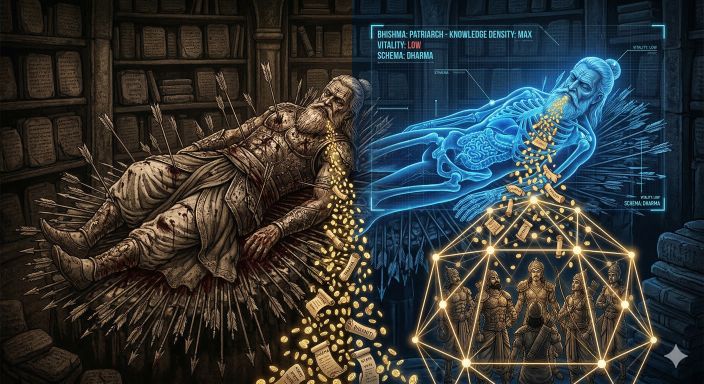
The Anushasana Parva of Mahabharata is essentially a “Civic” junk drawer where later redactors stored everything they wanted to legalize or preach. If the Bhagavad Gita is a philosophical interlude, the Anushasana Parva is a collection of dharmic manuals containing a code book designed to turn the Mahabharata into an instrument of social control, as the language shifts significantly from the “Heroic” style to a “Smriti” style (legalistic).
In the “Heroic” layer of Jaya, Bhishma’s death might have been a solemn, warrior’s exit. But in this final “Civic” expansion, he is kept on a bed of arrows for thousands of verses to deliver the Anushasana Parva (The Book of Instructions). This book is focused about the patronage to the priesthood and volumes of sermons on random subjects.
1. The “Chatty” Misogyny:
One of the most jarring “seams” in this Parva is the sudden shift into “random chatty discussions” regarding the nature and character of women.
- The Narada-Panchachuda Dialogue
This is widely cited by scholars like V.S. Sukthankar and Bibek Debroy as a prime example of “Misogynistic Interpolation”.
- Yudhishthira asks Bhishma about the character of women. Bhishma quotes a conversation between the celestial nymph (Apsaras) Panchachuda and the sage Narada.
- The Apsaras gives a scathing, highly generalized critique of women’s “lustful and fickle nature.”
- One of the observations is that the women do not care for lineage, beauty, or age, and are driven solely by desire.
- In DhanaDharma (Upa) Parva, Bhsihma answers Yuthishthira thus:
“There is no one who is more evil than women. A woman is the flame of a fire. She is Maya’s maya. She is the sharp edge of a razor. She is the poison of a snake. A woman is all these, and death, come together. Men are incapable of ever restraining them.”
The Scholarly Critique: V.S. Sukthankar noted that these sections are “later encrustations” reflecting a shift toward a more ascetic, patriarchal social order. By putting these words in the mouth of an Apsaras, the redactors tried to give the critique “internal authority”—as if women themselves were admitting to these flaws.
2. “Kama-shastra” interpolation:
Yet another major point of “dissonance” is the dialogue found in the Anushasana Parva on the question of who derives more please from a sexual intercourse – male or female!
It is a narration of the story of King Bhangashvana, who was transformed into a woman and thus could speak from both perspectives who concluded that the pleasure of the woman is greater!
In the BORI Critical Edition, this episode is found in Anushasana Parva, Chapter 12.
The Critical View: Why it’s “Ridiculous”
- The Setting: Bhishma is lying on a bed of arrows (Sharashayya), slowly dying while waiting for the winter solstice (Uttarayana).
- The Topic: Discussing the mechanics of sexual pleasure in this setting feels “out of character” for both the grieving Yudhishthira and the celibate Bhishma.
- The Interpolation Theory: Scholars like M.A. Mehendale and V.S. Sukthankar viewed such passages as “Kama-shastra” (Erotology) interpolations. Since the Mahabharata was being expanded into an “Encyclopedia of Everything,” the redactors felt it must include a discourse on sexual pleasure (Kama), alongside Dharma, Artha, and Moksha.
The Scholar’s Critique (Romesh Chunder Dutt):
R.C. Dutt was particularly scathing about these types of additions. He argued that:
- They destroy the “Virarasa” (Heroic Sentiment) of the epic.
- They turn a Great War Hero (Bhishma) into a “wandering storyteller” who lacks the dignity of his situation.
- They reflect a period of cultural decadence where the focus shifted from the “Hard Truths of War” to “Curiosities of the Bedchamber.”
Beyond the misogynistic ramblings and the sex-pleasure debate, there are several other “ramblings” one could find in the Anushasana Parva.
-
Dietary preferences (Meat Debate):
Yudhishthira asks Bhishma about the consumption of meat, leading to a long, often contradictory discourse. The text swings between acknowledging that warriors eat meat and arguing for total Ahimsa (non-violence). Likely influenced by the rise of Jainism and Buddhism.
-
Oblations to the departed & their periods of validity (DhanaDharma Parva):
“If sesamum, rice, barley, kidney beans, roots and fruits are given at funeral ceremonies, the ancestors are satisfied for a month. Fish for two months; Lamb for three months and rabbit meat for four months; Meat of goats for five months. It is six months with the meat of boar and seven months with the flesh of birds. With the meat of buffaloes, for eleven months. The product from a cow would last for an entire year.”