Unmasking the Layers of the Great Epic Mahabharata
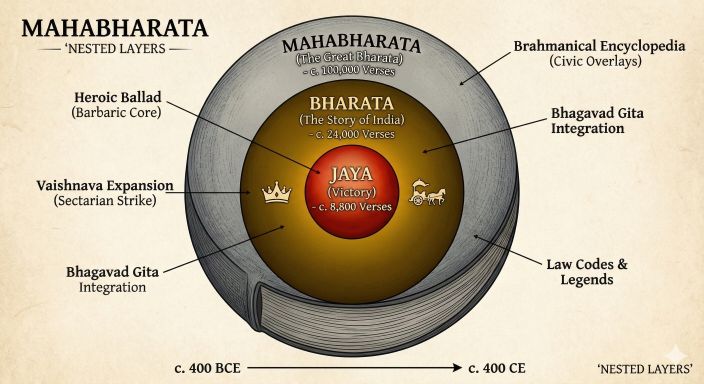
The Mahabharata is often called the “Fifth Veda”. When we open the Mahabharata, we often assume we are reading a single, static, sacred book. But what if I told you that you are looking at a literary metropolis built over thousands of years? It is less a static scripture and more a living, growing organism. Over millennia, it has breathed and expanded, growing from a core heroic ballad of 8,800 verses into a massive “Sata-Sahasri Samhita” (the 100,000-verse collection).
The Three Stages of Expansion – From Ballad to Encyclopedia
As scholars like V.S. Sukthankar of the Bhandarkar Oriental Research Institute (BORI) have highlighted, the epic has grown in three distinct historical phases, though the boundaries remained porous for centuries:
1. Jaya (Victory) c. 8800 Verses: The raw, “Barbaric” core, “knotted” or “difficult” verses (Kuta-shlokas) attributed to Vyasa, focused strictly on the gritty reality of the Kuru-Pandava war.
अष्टौ श्लोकसहस्राणि अष्टौ श्लोकशतानि च ।
अहं वेद्मि शुको वेत्ति सञ्जयो वेत्ति वा न वा ॥
(Adi Parva, 1.1.81)
Translation: “Eight thousand and eight hundred verses I (Vyasa) know; Shuka knows them, and Sanjaya may or may not know them.”
2. Bharata: Expanded to c. 24,000 Verses: This layer introduces the “Sectarian Strike,” where the “Upabrahmana” (expansion of the Vedas) begins. Krishna starts his transition from a brilliant diplomat to a central divine figure.
चतुर्विंशतिसाहस्रीं चक्रे भारतसंहिताम् ।
उपाख्यानैर्विना तावद्भारतं प्रोच्यते बुधैः ॥
(Adi Parva, 1.1.101)
Translation: “He (Vyasa) compiled the Bharata Samhita consisting of twenty-four thousand verses. Without the secondary tales (Upakhyanas), this is called the Bharata by the learned.
3. Mahabharata: c. 100,000 Verses. The final “Civic” encyclopedia, credited to Ugrashravas Sauti (Bard) at the 12-year Yagnya in Naimisharanya being conducted by Rishi Kulapathi Shaunaka. Traditionally, such itihasas and puranas were propagated only by the bards. Massive amounts of moral, ethical, and legal discourse (Dharma) were layered onto the war story to turn it into a social textbook.
लक्षं श्लोकसहस्राणां भारतस्य महात्मनः ।
इदं तु चतुर्विंशतिसहस्रं भारतं विदुः ॥
(Adi Parva, 1.1.101-106)
Translation: “The Great Bharata consists of one hundred thousand verses… but the Bharata known to the learned is twenty-four thousand.”
The Anatomy of Interpolation
As the epic traveled via oral tradition, it became a “fluid text.” Bards reciting in different regions were influenced by local pundits, grammar, and sectarian pressures. These interpolations weren’t just “filler”; they were deliberate “Sectarian Strikes” or “Didactic Overlays” designed to update the epic for its time.
- Philosophical Padding: The Bhagavad Gita is the most famous example. While seamlessly woven in at the start of the war, its linguistic and philosophical depth marks it as a later, distinct, refined layer compared to the surrounding battle narrative.
- The Law Manuals: The Entire books, like the Shanti and Anushasana Parvas, were inserted to detail priestly duties, charity (Dana) to Brahmins, and law codes, thus transforming a story of war into a manual for kingship and ethics with discourses on statecraft, social conduct etc.
- Geographical Fingerprints: As the epic migrated along diverse oral trajectories, bards integrated localized rituals and geography as well as local influences in sectarian devotional biases, evolving the narrative into an elastic fluid text. The BORI Critical Edition spent decades meticulously “pruning” these regional overlays to recover the “common ancestor” of the text.
- The Appendix (Khila): The Harivamsa was added later to integrate the complete biography of Krishna into the Kuru cycle.
The Quest for the “Original”: The Sukthankar Audit
In 1919, Dr. V.S. Sukthankar and his team of scholars took up the gargantuan task of compiling the Critical Edition. By comparing 1,259 manuscripts from across South Asia, his team used a “stemmatic” method to peel back the layers.
They looked for “Manuscript Consensus.” If a story—like the famous myth of Ganesha writing the epic—appeared only in later regional versions, it was moved to the footnotes. What remained in the main body was the “common ancestor” of all Indian versions.
Fingerprints of a Civilization
To remove these interpolations is to find the “original” story, but to keep them is to witness the evolution of a civilization. However, as M.A. Mehendale and Bibek Debroy have noted, some additions are overtly partisan or prejudiced, inserted into the flow like rough patches on a fine silk cloth.
Conclusion: The Auditor’s Path
In this series, we aren’t just reading the story; we are auditing it. We will wade through the maze of Upa-parvas and partisan narratives to find the “Heroic Core” that lies beneath the “Civic” polish.
The Mahabharata we read today is a massive, 100,000-verse encyclopedia. But beneath the miracles, the divine interventions, and the moralizing “shanties” lies a raw, 8,800-verse audit of a civilization’s collapse.
Very good attempt. Bring out other instances of distortions and interpolations too.
Wish you luck.
Very good attempt. Bring out other instances of distortions and interpolations too.
Wish you luck.
Good research.
But sounds a bit overly complicated to comprehend. Pretty sure there was a lot of goodness and takeaways from that culture that can be of positive influence on the reader including the Gita.