Mahabharata Redactions – those approved by BORI & the parts rejected
The “Approved” Redactions – When the Critical Edition still hides a Secret
There is a vital distinction to make. Just because a verse is “Critical” doesn’t mean it is “Original.” As Dr. Sukthankar himself noted, though the Critical Edition represents the oldest reachable version which is found uniformly in all available manuscripts, even that version had already been subjected to centuries of orthodox and devotional “polishing.”
The BORI Critical Edition is our most honest tool, but it has a limit. Some interpolations were so successful and so ancient that they achieved “Manuscript Consensus.” They are found in every version from Kashmir to Kerala, but when we apply a “Barbaric” audit, the seams still show.
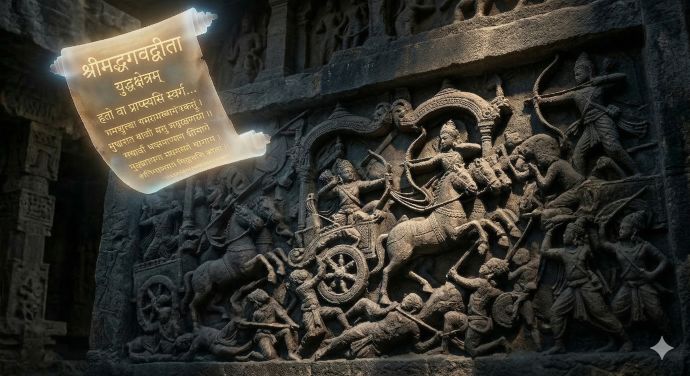
1. The Bhagavad Gita: The Ultimate Strategic Insertion
The Gita is in the Critical Edition. It is ubiquitous. But many scholars, including Van Buitenen, argue it is a highly sophisticated “Sectarian Strike.”
- The Reason: It interrupts a high-tension battle narrative with 700 verses of refined Samkhya and Bhakti philosophy.
- The Seam: In the “Heroic” layer, a warrior’s hesitation is settled by an appeal to his pride or clan-duty (Kshatriya-Dharma). The Gita layers a “Civic” cosmic justification over a “Barbaric” moment of doubt.
2. The Shanti & Anushasana Parvas: The Post-War “Livelihood” Overlay
This massive book of instructions by Bhishma is part of the constituted text of “Critical” edition, yet it feels like an encyclopedia was dropped into a tragedy.
- The Reason: After the 18-day war, the story should logically move to the funeral and the fallout. Instead, it freezes for thousands of verses of law and statecraft.
- The Seam: This represents the period where the Mahabharata was being used as a Manual for Kings. The “Pundit’s Livelihood” (mandatory ‘Dhana’ to Brahmins) depended on making the epic a textbook, so they turned the dying Bhishma into a legal professor.
- Kisari Mohan Ganguli, the first translator of the whole epic into English (available online in Sacred-Texts web site), has observed as follows in his forward to the Santi Parva:
“The Santi Parva is a huge interpolation in the Mahabharata, in the genre known as ‘wisdom literature.’ The narrative progression is placed on hold almost from the first page. Instead we get a long and winding recapitulation of Brahmanic lore, including weighty treatises on topics such as kingcraft, metaphysics, cosmology, geography, and mythology. There are discussions of the Sankya and Yoga philosophical schools, and mentions of Buddhism. It is apparent that the Santi Parva was added to the Mahabharata at a later time than the main body of the epic.”
3. The “Divine” Nature of Krishna’s Missions
While the Critical Edition keeps Krishna’s divine status, the “Heroic” remnants show a man who fails.
- The Seam: In the Udyoga Parva, Krishna goes as a peace envoy and displays his Vishwaroopam (Cosmic Form) to intimidate the Kauravas, but it was in vain.
- An insight: A “Barbaric” chieftain being ignored makes sense; a God showing his cosmic form and still being ignored is a narrative seam that suggests the Vishwaroopam was a later “Sectarian” magnification.
The “Rejected” Layers – What BORI Left in the Footnotes
This is where our analysis gets gritty. These are the stories we grew up with, but they failed the “Forensic Test” of manuscript consensus. BORI moved these to the Appendix (Parishishta).
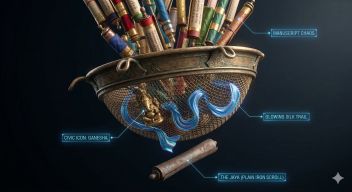 1. The Ganesha Myth: The Divine Stenographer
- The Rejection: This story is absent in almost all older Southern, Saradha, Nepali, Maithili and Bengali manuscripts.
- The Reason: It was a late “Civic” attempt to give the epic a divine “Vedic” status. If Ganesha wrote it, it must be infallible.
- The Auditor’s view: The original Jaya was transmitted through a bardic oral tradition since the written word was yet to be invented. A divine scribe was a later “Sectarian” promotion.
2. The “Endless Sari” Miracle (Draupadi’s Vastrapaharanam)
- The Rejection: In the oldest manuscripts, the miracle of the cloth is either absent or vague.
- The Reason: The oldest texts focus on Draupadi’s fierce legal interrogation of the Kuru elders.
- The Auditor’s view: Later redactors felt that a woman’s legal logic wasn’t enough to save her—she needed a Divine Rescue. By adding the miracle, they shifted the power from her intellect to Krishna’s grace.
3. The “Andhe ka Putra” (son of a blind man) Insult
- The Rejection: The famous line where Draupadi mocks Duryodhana’s blindness at the Maya Sabha is largely missing from the Critical Edition.
- The Reason: It was an interpolation designed to make Duryodhana’s subsequent rage look like a “Barbaric” overreaction to a petty insult.
By removing this, we could see a much darker reality: Duryodhana didn’t act because he was “offended” by a giggle; he acted because the Pandavas’ wealth represented a Biological and Political threat to his line. But he did complain about Droupadi’s giggle!