The Gene-Pool Crisis and the Niyoga (surrogacy) Strategy in Mahabharata
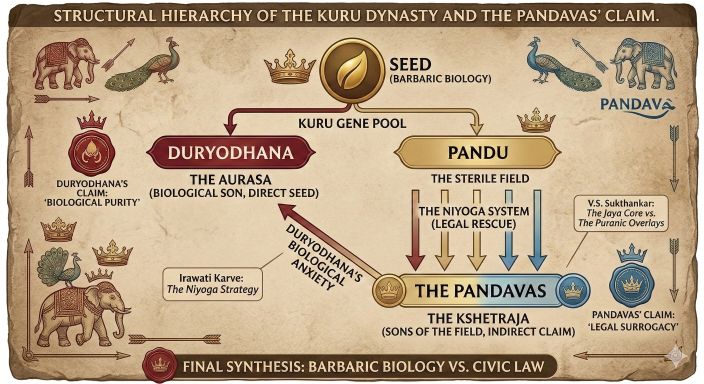
A critical juncture in the epic: the Kuru dynasty was facing a biological extinction!
If the Mahabharata is a record of a “Great Victory”, it begins with a “Great Bankruptcy”. The Kuru dynasty faced a biological dead-end that required desperate measures.
1. The Biological Dead-End
The Kuru line faced a crisis when King Vichitravirya died childless. But all was not lost, for there existed a solution. According to the ancient code of the time, the “Field” (the Queen) had to be sown with “Seed” from an “Appointed” surrogate to ensure the lineage continued. This wasn’t a scandal. It was an accepted strategy of the times and the practice had a name – “Niyoga”! And the offspring born through that method was called , “Kshetraja”. (As against this, the progeny born to the legitimate husband and his legally wedded wife in the normal course was called “Aurasa” (औरस).)
2. The Vyasa Intervention
The queens (Ambika and Ambalika) were impregnated by Krishna Dwaipayana AKA Vyasa – described as a dark, unkempt, and “terrifying” sage. He was the half-brother of King Vichitravirya. (That is another legend, which in fact is the first story when the epic proper begins – the tale of King Uparichara Vasu of Chedi and that of the union of Sage Parashara and Satyavati.) The Queens’ reactions (closing eyes, turning pale) during the process resulted in the births of the blind Dhritarashtra and the pale Pandu.
The birth of the third son – Vidura:
Since both offspring were born defective, a loyal maiden (Parishrami) was sent to Vyasa. Since she received him with respect and fearlessness during the ritual, Vidura was born healthy and perfectly wise. While highly respected for his wisdom, Vidura was considered a shudra (due to his mother’s station) and could not inherit the throne, though he became the primary advisor to Hastinapura kingdom. But he played a key role in the whole epic.
3. The Niyoga Redux and the Pandava’s “Divine” Births
The most significant “seam” in the gene pool is the birth of the five Pandavas. Because King Pandu was cursed and could not father children, Kunti and Madri used mantras to summon the Devas (Dharma, Vayu, Indra, and the Ashwins) and got sons from them.
The Scholar’s View:
Irawati Karve observes in her monograph titled “Yuganta” thus:
The Mahabharata records many miraculous events, some of which seem to be later additions made to explain away the human weaknesses displayed by those heroic people. There are others which cannot be so easily accounted for. A son being born to Kunti from the Sun-god falls in the first category. Kunti was serving a Brahmin for a year and that she should bear him a son was not such an extraordinary occurrence.
There is a record in the Mahabharata itself of another woman, Satyavati, Kunti’s grandmother-in-law, having had a child before marriage by a Brahmin.
Ms. Iravati Karve feels that the whole narrative that in the forest, a sage cursed Pandu that union with a woman would prove fatal to him, seems to be a later addition which tried to hide some congenital defect in Pandu. That is quite possible since he was afflicted with “Pandu roga” (pallor, decreased vitality, anemia etc) from birth.
Pandu must have known this lack in himself. There does not seem otherwise to be any reason for his retiring to a forest with his two queens in the prime of life. It might have been a fact that all the Kuru kings were addicted to hunting but that could not have been his reason, for, they did not take their queens along with them to the hunts! Hence it is plausible that Pandu had gone to the forest with the intention of living there. Did he intend that some other man should beget children on his queens? Did he wish to carry out this plan away from the capital so that nobody should know the identity of the fathers of the children? This appears to be the case because he did get his five sons in this manner. Why did he remain there after getting the sons? Possibly in the hope of getting some more.
4. The “Seed vs. Field” Conflict
This interpolation created the central legal tension of the epic that resulted in the Kurukshetra war:
- Duryodhana’s Claim: He was an Aurasa (biological son of the King). He represented “Seed” purity.
- The Pandavas’ Claim: They were Kshetraja (sons of the Field). But the logic that was working in the mind of Duryodhana is that though legally they were Pandu’s sons, but are ipso facto biological “outsiders.”
By polishing the births of the Pandavas, the later editors tried to hide a “Barbaric” succession crisis under a “Civic” divine mystery. But the “seams” remain. Though legitimate according to the custom of the period, the questionable parenthood lingered in the air throughout that resulted in the catastrophic war.
There is yet another twist to the whole parentage conundrum pervading the Mahabharata.
In the final chapters when the elders retired to the forest, the following intriguing narrations offer a possibility of altogether a different father to Yudhishtira.
1. In one of visits of Yudhishtira to the forest to the elders, he went in search of Vidura and found him in an emaciated condition. Vidura embraced Dharma and entered Dharma’s body limb by limb, with his yogic power. Vidura gave Dharma everything — his life, his organs, his brilliance. This behaviour at the time of death is like that between father and son. In the Brihadaranyaka Upanishad (also in Kaushitaki Upanishad) there is a description of such a process called “Sampratti” which is a rite of transmission—the passing down of the lineage, wisdom, and duties of a father to his son before the father’s death.
2. Later on, Vyasa came to Dhritarashtra and said, “Vidura was Yama incarnate born to Vichitravirya’s maidservant and me through my yogic powers; and he in his turn, through yogic powers, gave birth to Yudhishthira, the king of the Kurus. He who is Dharma is Vidura; he who is Vidura is Pandava.”
The above narration can be found in the Ashramavasika Parva in the Critical Edition of Mahabharata.
When Pandu and Kunti were planning to call gods to father the children, it is very curious that the first god Kunti called was Yamadharma, the god of death. Vidura was said to be an incarnation of Yamadharma, so can we surmise that she did not call the god but her husband’s brother Vidura?
The Mahabharata does not hide anybody’s secrets. But why this possibility alone has been shrouded in cryptic verses? Beats me!
- The Anushasana Parva – The Pundit’s Manual and Endless Ramblings
- The Mahabharata’s Genetic Lab: Ranking the Epic’s Most Bizarre Births