The Mahabharata’s Genetic Lab: Ranking the Epic’s Most Bizarre Births
Introduction
Let’s face it: the Mahabharata doesn’t do normal family trees!
If you strip away the romanticized television retellings and audit the actual text, you quickly realize that the standard human womb is practically an endangered species in Kuru dynasty. Whenever a character is destined to completely rewrite the political order, shatter a dynasty, or flip the socio-political balance of ancient Bharat, the birth sequence completely rejects regular human biology.
Instead, we enter a surreal, ancient genetic laboratory. We are introduced to human lives engineered out of involuntary semen spillages, aerial interceptions, cross-species aquatic incubation, embryo-splitting, and non-uterine fire manifestations.
Why did the ancient redactors abandon basic anatomy to write these bizarre accounts?
These are not just wild fairy tales or primitive sci-fi; may be they are calculated narratives of supernatural stories to “patch up” the deep biological issues of the various characters. These layers of divine and elemental miracles might have been introduced by the redactors to inspire awe since the epic that is meant to last for thousands of years!
Here is a structured breakdown of the most “bizarre births” in the Mahabharata, ranked in increasing order of biological and metaphysical weirdness.
11. Dhrishtadyumna and Draupadi (Born of Fire)
King Drupada of Panchala wanted vengeance against Drona. Since he couldn’t defeat Drona through normal military means, he turned to a complex sacrificial ritual (Yajna) managed by the sages Yaja and Upayaja.
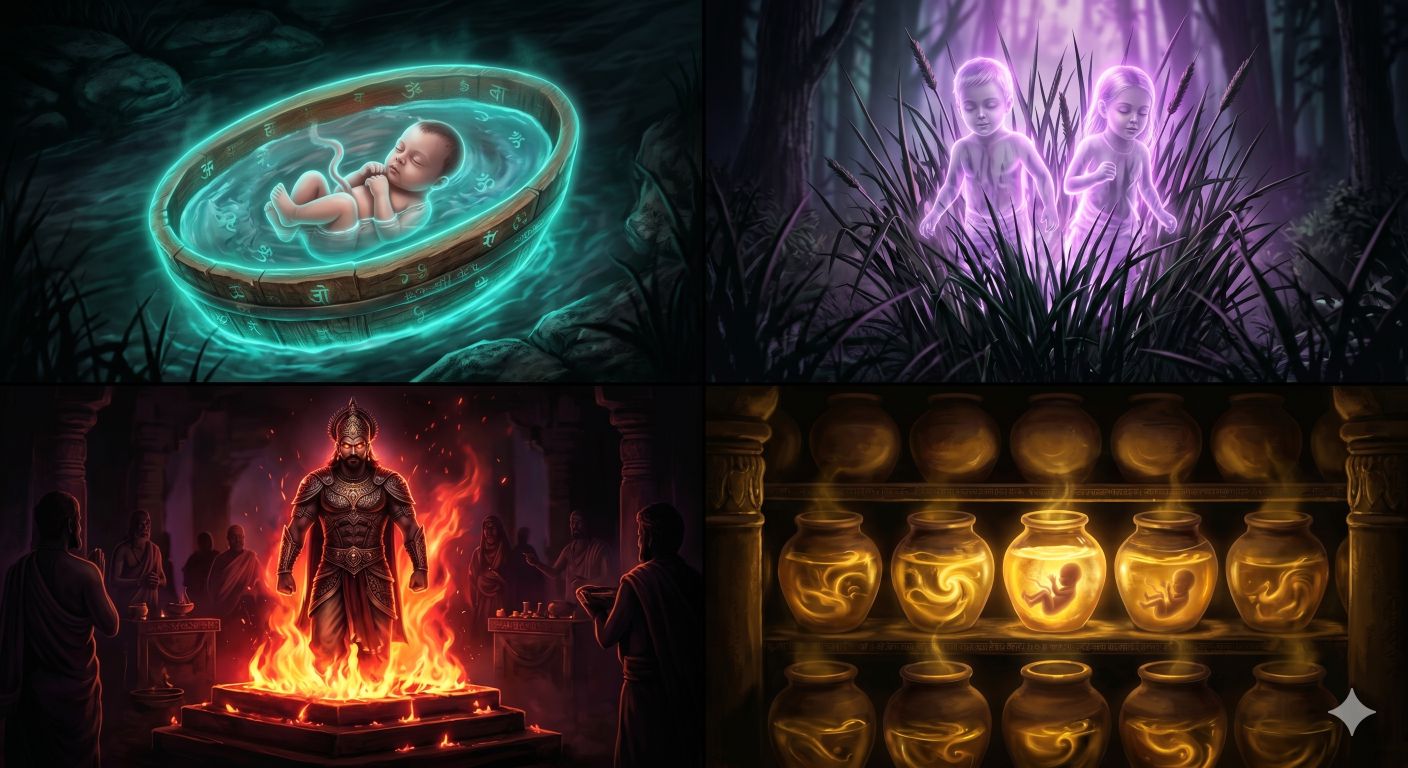
This was an artificial, non-uterine manifestation. At the climax of the sacrifice, instead of a baby being born, a fully grown, armor-clad adult warrior (Dhrishtadyumna) stepped directly out of the sacrificial fire pit, followed immediately by a fully grown young woman (Draupadi).
10. Devavrata / Bhishma (Born of a River)
King Shantanu fell in love with a mysterious woman on the banks of the Ganges, who was actually the goddess Ganga in human form, executing a curse laid upon the celestial Vasus.
While the birth itself was uterine, the environment and survival rate were abnormal. Ganga gave birth to eight children. She systematically drowned the first seven neonates in her own river waters immediately after birth. The eighth child, Devavrata (Bhishma), was spared only because Shantanu broke his vow of silence to protest.
9. Lust of a mountain for a river and subsequent weird birth!
King Uparichara (literally, someone who travels through the upper region) also known as Vasu ruled Chedi kingdom in which a river named Shuktimati was once attacked by the mountain Kolahola, maddened by lust. The mountain Kolahola was kicked by King Vasu with his foot and the river flowed out freely through the gully caused by the kick. From the embrace of the mountain, the river gave birth to twins and, grateful, the river gave them to the king. The daughter of the river was named Girika and the king Uparichara made her his wife.
(The same king Uparichara Vasu will figure in yet another episode of a still more bizarre birth!)
8. The Kauravas (Born from a Mass of Flesh Cleaved into 101 Jars)
Gandhari was pregnant for two long years, but instead of a child, she delivered a hard, cold, unformed mass of flesh resembling a ball of iron. In frustration and despair, she was about to throw it away.
Sage Vyasa intervened. He instructed that the mass of flesh be sprinkled with cool water, causing it to naturally divide into 101 distinct, living embryos (for 100 sons and 1 daughter). Each embryo was then placed into an individual earthen jar (Kunda) filled with clarified butter (Ghee) acting as an artificial womb environment. They incubated in these jars for another year before emerging as infants.
7. Amorous rape and overlapping embryo!
In earlier times, there was a famous rishi named Utathya. He had a beautiful wife named Mamata. Utathya’s younger brother was Brihaspati, the priest of the gods. One day he desired Mamata and sought to have intercourse with her. Mamata told her brother-in-law, “I am pregnant through your older brother. Therefore, desist”. But Brihaspati could not suppress his desire and united with her against her will. When he spilt his semen, the embryo inside the womb said, “O Uncle! There is no room inside for two of us. I was here first” and stopped the fluid with his feet. At this Brihaspati was angry and cursed Utathya’s son, who was in the womb with blindness. The child was born blind and he was Rishi Dirghatamas (meaning long darkness), who was the seer for many mantras of Rig Veda. He also set rules for marriage and Niyoga.
Now what about the abandoned Brihaspathi’s semen? Well, that is another equally weird tale, not available in Mahabharata but stated in Bhagavata Purana. It turned into Sage Bharadwaja – Bhara-dwajam (born of two fathers!). He appears later on in Mahabharata as described in the succeeding episode.
6. Drona (Born in a Wooden Vessel / Cup)
The great sage Bharadwaja had gone to the Ganga for a bath when he spotted the Apsara Ghritachi emerging from the water. The wind blew her garment away. The sage ogled at the naked beauty and at that instant he experienced a semen emission. He quickly gathered the spilt biological fluid and deposited it into a wooden cup (Drona). The fluid incubated inside this container without any human womb, eventually developing into a fully formed baby boy, who was named Drona (“Born from a vessel”).
This is an early textual example of an in-vitro style ectogenesis. It completely bypasses the female anatomy or her embryo, establishing Drona as a purely paternal, ascetic creation, which mirrors his later rigid, uncompromising personality.
5. Rishyashringa (Born of a Deer)
The ascetic sage Vibhandaka went to a great lake and stayed there for a long time, engaged in austerities. There, when he was washing in the water, he saw the apsara Urvashi and spilt his semen overwhelmed by passion. A thirsty doe which was drinking water from the lake accidentally swallowed the floating semen.
(Here Mahabharata states an universal fatalistic truth – “Whatever has been decreed by destiny and laid down by fate must inevitably happen”.)
From that doe was born a son, the great rishi Rishyashringa. He was born fully human but bore a single, prominent horn on his head, earning him the name Shringi (or Rishyasringa).
4. Satyavati and Matsya ( The Aerial Semen Logistics)
It’s Uparichara Vasu again!
Once, when Vasu’s wife, Girika, informed her husband that she was fertile, the king had to proceed on an errand. But the thought of Girika who was exceedingly beautiful, made him so excited that his semen was discharged in the forest and he collected it in the leaf of a tree. And then sent it through a hawk to his wife. But an aerial dogfight with another hawk caused the leaf to puncture, dropping the bio fluid into the Yamuna river. It was swallowed by an Apsara cursed into the form of a fish (Adrika). When a fishermen caught and slit open the fish, they found twins: a boy (Matsya) and a girl (Satyavati).
This Satyavati was the Matriarch of Kuru dynasty!
3. Spilt Semen split by weed turned into human twins!
Sharadvan (the descendant of Gautama) was so hyper-focused on archery and asceticism that Indra sent the Apsara Janapadi to break his focus. Upon seeing her, his vital fluid escaped involuntarily. He fled in shame, but his spilled semen fell onto a clump of sharp forest reeds. The structure of the reeds physically split the fluid into two halves, which then incubated in the open air until they materialized into a human twin boy and girl, later adopted by King Shantanu as Kripa and Kripi. This Kripacharya later became the archery teacher of Kauravas and Pandavas.
2. Birth of Skantha / Kartikeya (Multiple versions)
The birth of the war-god Kartikeya (Skanda) involves a chaotic, multi-tiered transfer of divine biological material that shatters regular physical boundaries.
Agni coveted the wives of Saptarishis (7 seven revered sages considered the mind-born sons of Brahma), but couldn’t get near them. When Agni went to a forest he was approached by sage Daksha’s daughter, Svaha who desired Agni. But he was only thinking of the rishis’ wives. So Svaha assumed the form of six out of seven wives of Saptarihis and had intercourse with Agni. (The seventh was Arundathi, wife of Vasishta whose form was not attainable by Svaha). On each night after the sex was over, Svaha would carry the semen and fly to a distant mountain, taking the form of a bird and throw the semen into a well there. Thus she did for all the six nights.
The energy of the semen that had fallen down gave birth to a son who got the name Skanda (fallen down). He had six heads, twelve ears, twelve eyes, twelve arms, one neck and one torso.
This is Vana Parva version. The birth of Skanda has been described differently in Shalya & Anushasana parvas of Mahabharata.
Maheshvara’s seed fell down into fire. But the Agni couldn’t destroy that seed. As per Brahma’s instructions, Agni flung that seed into Ganga. However, Ganga was also not capable of bearing that seed and flung it on the Himalayas. The Krittikas (a constellation of six stars) saw the blazing womb there lying down in a clump of reeds. The child assumed six mouths and drank milk from all their breasts. This is one version. But there is another one where the narration is different as follows:
Each of the six Krittikas (Pleiades) nurtured a part of Agni’s embryo which was divided into six parts and all of them carried it together.When the time for delivery arrived, all the Krittikas delivered at the same time. Though the six parts of the embryo had been delivered separately, they came together and united. So the child Skanda was called “Karthikeya”.
Strangely, there is yet another tale (as if as a compromise) in Markandeya Samsya UpaParva which states that Skanda was actually born of Rudra, with him entering Agni and Uma entering Svaha.
1. Yet another instance of Lord Shiva’s semen dispersal.
Rudra moistened Uma’s vagina with his semen which was thrown on the mountain and created Minjika and Minjikaa. The remaining semen flowed into the red river (BrahmaPutra). Other parts ascended into the rays of the sun and others fell on the earth. Still others adhered to the trees. Thus, it fell in five ways. They became ganas.
Mahabharata is replete with many such instances of semen spillage!